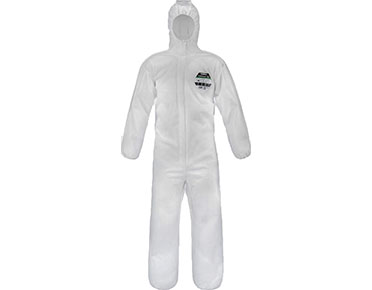
These white Lakeland SafeGard 76 Type 5/6 coveralls are made from a breathable SMMS fabric with bound seams for superior strength, comfort and promotion of air permeability. These disposable coveralls provide Type 5/6 protection. Highly breathable so comfortable to wear Excellent protection against dry particles and splashes of liquids These disposable Type 5/6 coveralls are constructed with a 55gsm 4-layer SMMS fabric – a double layer of melt-blown fibre (‘MM’) to enhance hazardous dust protection while maintaining a high level of comfort The air permeability of this coverall is 10 times higher than other materials such as flash-spun polyethylene and microporous film laminate, resulting in much higher comfort levels Air permeability reduces the ‘bellows effect’ (the tendency to create suction of air and dust particles in the seam holes, cuffs, ankles and zip) Superior strong and durable bound seams offer additional protection against dust, liquid ingress* Super-B style design – this coverall has been developed for a superior fit, wearability and durability A crotch gusset is included to reduce incidence of burst crotch and improve durability All Lakeland coveralls are suitable for asbestos handling and removal Lakeland SafeGard 76 Type 5/6 coveralls are also available in blue and orange Typical applications include: Asbestos handling and removal “Dry” applications in fibreglass manufacturing Boatbuilding Windblade or similar manufacturing environments Wood and plastic processing Insulation handling and removal General manufacturing and maintenance Low level / low hazard sprays ________________________________________________________________________________________________________________________________ Which garment to use: Light Spray TYPE 6 Hazardous dust TYPE 5 Liquid Spray TYPE 4 Jet Spray TYPE 3 Gas or Vapour TYPE 1&2 Light spray/aerosol protection Dry particle protection General overall spray: no pressure but coverall soaked Strong jet sprays – higher pressure Surrounding gases or vapours Physical factors such as strenuous work? The physical demands of a task such as climbing ladders, crawling or working in confined spaces, especially if the chemical is highly toxic, may require higher strength fabric or a specific design, even though permeation analysis and/or the hazard spray type indicate a lighter/more comfortable garment. Liquid or gas? Liquid would normally suggest a Type 3 or 4 hazard. However, some chemicals have low boiling points, becoming vapour at low temperatures. In such cases a gas-tight suit might be appropriate. Such information can be obtained from Safety Data Sheets. Type 3 vs Type 4 – the different spray tests EN 14605 – Type 3: ‘jet’ sprays EN14605 – Type 4: ‘liquid’ sprays Strong, directional jets of liquid spray Results in intense, local pressure on fabric, seams and joins Back-spray will penetrate under, up or behind any loose flaps or joins In finished garment spray test, single jets of liquid are sprayed at ‘potential’ weak areas of suit (seams, crotch, zip flap ect.) Wider, less pressurised liquid sprays Results in saturation of fabric (so sealed seams required) but no pressure on garment, seams or joins No risk of back-spray penetrating under, up or behind loose flaps or joins In finished garment spray test, four nozzles with general overspray of liquid By identifying that your application is Type 4 only (rather than Type 3), this enables more options for garment design and choice, along with a greater level of comfort. *About bound seams The seam is wrapped with a folded strip of similar or stronger material and chain-stitched through all five layers in a single operation. This results in a tougher seam which also provides improved liquid and particle repellency at the seams as well as a tougher garment all round. A bound seam is not suitable for a chemical suit as it is not liquid tight.
All hand tools come with a lifetime warranty through Tecra Tools. Cases follow the manufacturer’s warranty and are handled via Tecra Tools. Warranties for test equipment and power tools must be addressed directly with the manufacturer for repair or replacement. Please see our full Warranty Policy.
All returns must be pre-authorized and clearly marked "returned goods" and returned within 10 days (customer is responsible for all return shipping costs). Custom Cases, Custom Kits, Special Order Items (SPC's), Replacement Parts, Clearance/Sale/Promo Code Items and Test Equipment are Non Exchangeable, Non Returnable or Non Refundable. Exceptions may apply but not without prior authorization from Tecra Tools. Please see our full Return Policy.
Pricing Policy
All prices listed on Tecra Tools' website reflect the most accurate and up-to-date information available. If an "original price" or "discounted price" is displayed, the original price represents the price at which the product was offered in the past for a reasonably substantial period of time. Any "sale" or "discount" applies for a limited time as specified on the product page. Tecra Tools reserves the right to modify or update pricing without notice. For further details about pricing, see Terms & Conditions or please contact us at 1-800-284-0808 or [email protected].
Shipping Policy
Our website does not reflect live inventory, except for a select number of items. In stock products will ship within 72 hours. If your order is in stock, but received after 2 PM MST, your order will be processed and shipped on the next business day. If you are needing a product by a certain deadline, please reach out to us at [email protected] or call 303-338-9224 and we can provide you more information. See full shipping policy at Term & Conditions.
Customer Support
For questions or concerns, please contact us at:
- Email: [email protected]
- Phone: 303-338-9224 or 1-800-284-0808
- Business Hours: Mon-Thur. 8 AM – 5PM MST
California Proposition 65
Certain products may contain chemicals known to the State of California to cause cancer, birth defects, or other reproductive harm. For more information, visit Chemical Exposure Warnings (Proposition 65 Warnings).